
I sat in my truck for fifteen minutes, engine idling, sweating through my shirt while I stared at a draft message on my phone. I had just finished a massive landscaping job. The lawn looked like a golf course, and the client was thrilled. But there I was, terrified of hitting ‘send’ on a simple request for a Google review. I felt like a telemarketer. I felt desperate. That hesitation cost me thousands in potential leads because my profile stayed stagnant while competitors with half my skill scooped up the Map Pack spots. It’s a paralyzing feeling, isn’t it? You don’t want to be the person who pesters, yet you know that without those little gold stars, you’re basically invisible to anyone searching on their phone. I eventually sent a weak, apologetic text that sounded like I was asking for a kidney. Silence. It was then I realized that my approach was all wrong. I wasn’t just failing at getting reviews; I was failing at building the kind of authority that forces Google to take notice. I spent the next few months testing different scripts and timings until I found the sweet spot.
Your Customers Actually Want to Help if You Don’t Make it Weird
I’ve spent a decade in the trenches of local SEO, and if there’s one thing I’ve learned, it’s that most small business owners are far too polite for their own good. We worry about ‘interrupting’ or ‘bothering’ people who have already shown they like what we do. My biggest mistake early on was the ‘Review Blast.’ I sent an automated, robotic email to every customer I’d had for three years. It was cold, it was late, and it resulted in exactly zero reviews. In fact, I think I actually annoyed a few regulars. I was focused on the number rather than the relationship. I was ignoring the fact that most local businesses get this outreach wrong by forgetting the human element. Today, we’re going to solve that. I’m going to share the exact framework I used to pull my own business out of the ‘no-review’ gutter. We’ll look at how to time your ask so it feels like a high-five rather than a chore. I remember one specific client, a local baker. I’d helped her with her site, and she was over the moon. I waited three weeks to ask for a review because I didn’t want to ‘crowd’ her. By the time I asked, the excitement had faded. That was my lightbulb moment: strike while the iron is hot.
Is it actually possible to get 5 stars without being a pest?
The skepticism is real. You’ve probably been on the receiving end of those desperate follow-up emails that come every three days. It feels gross. But here is a surprising fact: research from the Spiegel Research Center shows that the purchase likelihood for a product with five reviews is 270% greater than one with no reviews. People want to see those reviews because it makes their decision easier. When you ask correctly, you aren’t begging; you’re providing proof for the next person who needs your help. Have you ever stared at a perfect job and just… failed to ask for the shout-out? You aren’t alone. I’ve been there. We are going to fix that by making your request part of the service itself, setting the stage for a natural, high-authority profile that dominates your local area.
Plant the Seed Before You Pack the Tools
The trick isn’t in the follow-up; it’s in the setup. I call this the ‘Pre-Close.’ Instead of waiting until you’re back at the office to send a generic link, you need to mention the review while you are still standing in their driveway or finishing the project. I remember working with an HVAC contractor in Austin who was struggling to break into the top three. He was doing incredible work, but his Map Pack position was stuck on page two. We changed one thing: as he was showing the homeowner the newly installed unit, he’d say, ‘My goal today was to make sure this system runs perfectly for you. If I’ve done that, would you mind sharing that experience on Google? It’s how local guys like me keep the lights on.’ By the time he left the property, the review was often already live. This immediate feedback loop is vital because mastering authority stacking for elevated local rankings starts with real-world validation. 
Why Your Review is Just One Node in the Stack
Think of a single review like a single brick. It’s useful, but it won’t keep the rain out unless it’s part of a wall. In the world of SEO, that wall is your authority stack. When a customer leaves a review, Google sees a pulse. But if that pulse isn’t connected to other signals, the impact fades. You need to ensure that your digital footprint is cohesive. This means you should be fixing the citation gaps keeping you off the top 3 while you’re gathering those stars. If your address is slightly different on Yelp than it is on Google, that review loses its ‘weight.’ I’ve seen businesses with 500 reviews get outranked by someone with 50 simply because the latter had a tighter authority stack that acted as a game-changer.
Stop Killing Your Momentum with Messy Data
Execution is where most people trip. They get the review, but then they ignore their backlink profile. You should be looking for ways to bridge the gap between customer praise and search engine trust. This is where you might consider a specific backlink move for high-authority local press to announce a milestone or a community project. If you don’t keep the momentum going, your profile becomes a ghost town. I once audited a local plumber who had a sudden influx of 20 reviews in a week—a great result, right? Wrong. Google flagged him for spam because his underlying link structure was non-existent. He hadn’t bothered to audit his local backlink profile for spam gaps before the push. The lesson? Your ‘ask’ must be supported by a foundation of technical SEO that validates your business as a legitimate, local entity.Everyone tells you to just ‘get more links’ and ‘get more reviews.’ But here’s the truth I’ve learned after managing hundreds of local profiles: Google is getting smarter at spotting empty hype. You can have a thousand reviews, but if your backlink profile looks like a random assortment of unrelated websites, Google’s algorithm starts to smell a rat. The context is often more important than the raw data itself. In fact, many experts at Whitespark have noted that the relationship between reviews and actual local rankings is increasingly dependent on the ‘relevance’ of your entire digital entity. If you are a plumber in Phoenix but your only backlinks come from a lifestyle blog in London, you have a major context problem that causes Google to ignore your hard-earned authority. We need to shift the focus from ‘volume’ to ‘validation.’ One single link from a locally trusted source, like a neighborhood blog or a city council resource page, carries more weight than fifty links from a ‘private blog network’ that has no geographic ties to your shop. Think of it like this: if twenty people you don’t know tell you a restaurant is good, you might be skeptical. But if the local health inspector, the city mayor, and the food critic for the town paper all say it’s the best spot in town, you’re going there for dinner. That is the difference between generic backlinks and a high-authority local stack.
Quantity Alone is a Losing Game
Can Google actually verify you are where you say you are?
This is where most people fail to see the ‘matrix.’ It’s not just about being listed; it’s about being validated. When you build an authority stack, you are creating a web of proof. If your local entity sync isn’t perfect, you’re basically telling Google that your business exists in a vacuum. I’ve seen businesses plummet because their local entity sync is failing to validate their data across key platforms. You need to stop thinking about your website as a stand-alone island and start seeing it as the heart of a multi-node system. 
Avoid the Poison Pill of Cheap Link Packages
One of the biggest traps I see contractors and small business owners fall into is buying those ‘$99 for 5,000 links’ packages on freelance marketplaces. It feels like a shortcut, but it’s actually a suicide mission for your Map Pack ranking. These links are almost always ‘dead nodes’—they have no traffic, no relevance, and often come from domains that are already flagged for spam. There is a hidden danger of cheap link packages for small businesses that can lead to manual penalties or, worse, a quiet shadow-ban where you just stop appearing in ‘near me’ searches altogether. Google’s AI is designed to identify these patterns instantly. When you inject these toxic signals into your profile, you aren’t just wasting money; you are actively digging a hole that takes months of clean-up work to climb out of. Instead of volume, you should be focused on elevating your local SEO with advanced authority stacking tactics that prioritize geo-relevant signals over raw link counts. Another nuance that separates the pros from the amateurs is how they handle their anchors. If all your links use the exact same keyword, you’re practically begging for a filter. You have to stop using generic anchor text for local link campaigns and move toward a natural blend of branded, naked URL, and geo-specific terms. Have you ever fallen into this trap? Maybe you bought a ‘booster’ package or used the same keyword 50 times in a row? Let me know in the comments. We’ve all made mistakes, but the key is fixing them before the next algorithm update wipes you out.
Don’t Let Your Map Pin Fade Away
Most guys treat SEO like a one-off renovation. You paint the walls, fix the leaks, and then walk away. But the internet isn’t a building; it’s a garden. If you don’t weed it, the thorns take over in three months. I learned this the hard way when a competitor in the plumbing space systematically chipped away at my rankings while I was busy ‘doing the work.’ I realized that a successful map presence requires a local data loop strategy for sustainable map rankings. You can’t just set it and forget it; you need a system that constantly refreshes your authority nodes to keep the algorithm’s attention from drifting.
The Tools That Actually Earn Their Subscription
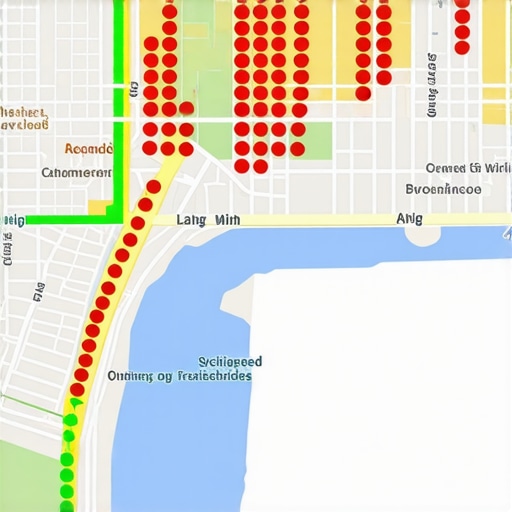
The first thing I do every Monday morning isn’t checking email—it’s checking my heat maps. I use tools like Local Falcon because it shows me exactly where my ‘influence’ stops in a physical grid. If I see a red dot three miles south of my shop, that’s where I need to focus my next outreach effort. If you aren’t doing this, your map tracking strategy is missing key data points that could tell you exactly where you’re losing money. I don’t care about a single ‘average’ rank number; I care about the geographic spread of my visibility across the neighborhood.
How do I maintain my authority stack over the long haul?
Maintenance is about finding the cracks before the foundation shifts. Every quarter, I run a deep scan using the local seo audit tool that actually finds map errors to ensure no one has ‘suggested an edit’ to my phone number or business name that I missed. This is where building an authority stack that doesn’t get flagged pays off. You want a structure that is so robust—built on multiple cloud platforms and high-tier directories—that a single NAP (Name, Address, Phone) error doesn’t topple your whole digital presence.
As you scale, you have to look beyond simple citations. I’ve started implementing the specific logic behind multi-cloud map stacks to distribute my business data across AWS, Google Cloud, and Microsoft Azure properties. This creates a ‘redundancy of trust.’ If one platform changes its algorithm, the others still validate my existence to Google’s primary crawler. Darren Shaw from Whitespark often highlights in his annual Local Search Ranking Factors survey that ‘consistency’ and ‘signals of prominence’ are the primary drivers of long-term success. This isn’t just theory; it is the backbone of how we beat the big franchises.
The Future is About Proof Not Proxies
Looking ahead, I predict that ‘synthetic authority’—stuff made purely by AI and automated link farms—is going to be nuked. Google is already moving toward an ‘Experience, Expertise, Authoritativeness, and Trustworthiness’ (E-E-A-T) model that prioritizes real-world signals. In 2025 and beyond, your digital footprint will need to be backed by physical evidence, like local sponsorships and community event participation. It’s the single most advanced tip I can give you: stop trying to trick the robot and start proving to the community that you actually exist. Go reach out to one local non-profit or neighborhood association this week to secure a high-trust sponsorship link and watch what it does for your credibility.
The Brutal Truth About My Failed Ranking Attempts
Looking back at my years of trial and error, I’ve realized that a review is never just a review. It is a timestamped confirmation of your physical existence in a specific zip code. If I could go back, I’d tell myself to stop obsessing over the raw 5-star count and start looking at the ‘geographic spread’ of where those reviewers actually live. Another massive realization was how easily a bad initial setup can kill your momentum; for instance, many people realize too late why your business profile category is limiting your reach before they even start their campaign. I also learned that you simply cannot out-review a toxic link profile. If you’ve been burned by ‘guaranteed’ ranking services in the past, you need to know how to fix your local backlink profile after a bad agency to give your new reviews a chance to actually move the needle.
The Gear That Keeps My Rankings Sharp
I don’t believe in using fifty different tools to manage a local presence. I keep it lean and focused on data that actually converts into phone calls. I rely on Local Falcon for ‘ground-truth’ visibility because standard rank trackers often give you false positives. For auditing the messy stuff, I swear by the local seo audit tool that actually finds map errors because it catches the subtle NAP inconsistencies that the human eye misses. I also highly recommend keeping Darren Shaw’s annual research bookmarked; it’s the only source I trust to cut through the SEO noise. If you are serious about scaling beyond one neighborhood, you must look into authority stacking strategies to dominate local search that utilize multi-cloud environments—it is the only way to build a profile that is truly resistant to algorithm updates.
#IMAGE_PLACEHOLDER_E#
Take Back Your Local Market Today
The digital landscape is crowded, and your competitors aren’t resting. But here is the secret: most of them are still doing the ‘lazy’ version of SEO. They are buying the cheap link packages and sending those late, automated emails that everyone ignores. By focusing on genuine human relationships and building a rock-solid authority stack, you aren’t just ranking higher; you’re building a permanent moat around your business. You have the framework now. The scripts are in your head, and the strategy is clear. It’s time to stop being invisible and start owning your neighborhood. What was the most awkward review request you ever sent? I’ve shared my ‘asking for a kidney’ story—let me know yours in the comments below!